Vietnam E-Visa Single vs Multiple Entry: Which One Should You Choose?
Compare Vietnam eVisa single vs multiple entry in 2026. Learn the key differences, fees, validity, and how to choose the right visa for your trip.
Planning a trip to Vietnam and wondering whether you need a single-entry or multiple-entry Vietnam e-visa? Choosing the right visa depends on your travel itinerary and whether you plan to leave and return to Vietnam. In this guide, Tubudd breaks down the key differences, costs, validity, and important considerations to help you prepare for your Vietnam trip.
vietnam-e-visa-single-vs-multiple-entry
Vietnam E-Visa Single vs Multiple Entry: What's the Difference?
The main difference is the number of times you can enter Vietnam using the same e-visa during its validity period.
Feature
Single Entry
Multiple Entry
Number of entries
One entry
Multiple entries
Official fee
US$25
US$50
Maximum validity
Up to 90 days
Up to 90 days
Leave Vietnam and return using the same e-visa
No
Yes, during the visa validity period
Suitable for
One continuous Vietnam trip
Trips involving multiple entries into Vietnam
The Vietnam Immigration Department confirms that Vietnam e-visas may be issued for single or multiple entry and can have a validity period of up to 90 days.
One important point to understand is that entry and visa validity are two different things.
For example, a 90-day single-entry e-visa does not mean you can enter Vietnam once every few weeks for 90 days. It means you can use the visa to enter Vietnam once during its validity period.
A multiple-entry e-visa, on the other hand, can be used for multiple entries while it remains valid.
What Is a Single-Entry Vietnam E-Visa?
A single-entry Vietnam e-visa allows you to enter Vietnam one time.
Once you use the visa to enter Vietnam and subsequently leave the country, that single-entry visa has been used. You cannot use the same visa to enter Vietnam again.
How Does a Single-Entry E-Visa Work?
Imagine your itinerary looks like this:
United States → Hanoi → Ninh Binh → Da Nang → Hoi An → Ho Chi Minh City → United States
You enter Vietnam once and remain in the country throughout the trip.
In this situation, a single-entry e-visa may be suitable because there is no planned departure from Vietnam before your final journey home.
How Much Does a Single-Entry Vietnam E-Visa Cost?
The official fee for a single-entry Vietnam e-visa is US$25.
The fee is paid online through the electronic payment system during the e-visa application process.
According to the Vietnam Immigration Department, the e-visa fee is not refunded if the application is refused.
How Much Does a Single-Entry Vietnam E-Visa Cost?
Who Should Consider a Single-Entry E-Visa?
A single-entry e-visa may be appropriate if:
You plan to enter Vietnam only once.
You will stay in Vietnam for your entire trip.
You do not plan to visit another country and return to Vietnam.
Your itinerary is a continuous journey through Vietnam.
For a straightforward Vietnam holiday, there may be no need to apply for multiple entry if you have no plans to leave and re-enter the country.
What Is a Multiple-Entry Vietnam E-Visa?
A multiple-entry Vietnam e-visa allows you to enter Vietnam multiple times during the validity period of the visa.
This can be particularly useful for travelers combining Vietnam with other countries.
How Does a Multiple-Entry E-Visa Work?
For example, consider this itinerary:
Hanoi → Da Nang → Ho Chi Minh City → Bangkok → Ho Chi Minh City → Home
You initially enter Vietnam, leave Vietnam for Thailand, and then return to Vietnam.
Because your itinerary includes two separate entries into Vietnam, a multiple-entry e-visa may be appropriate.
The same concept applies if you travel between Vietnam and Cambodia, Singapore, Laos, or another country during the validity of your visa.
How Much Does a Multiple-Entry Vietnam E-Visa Cost?
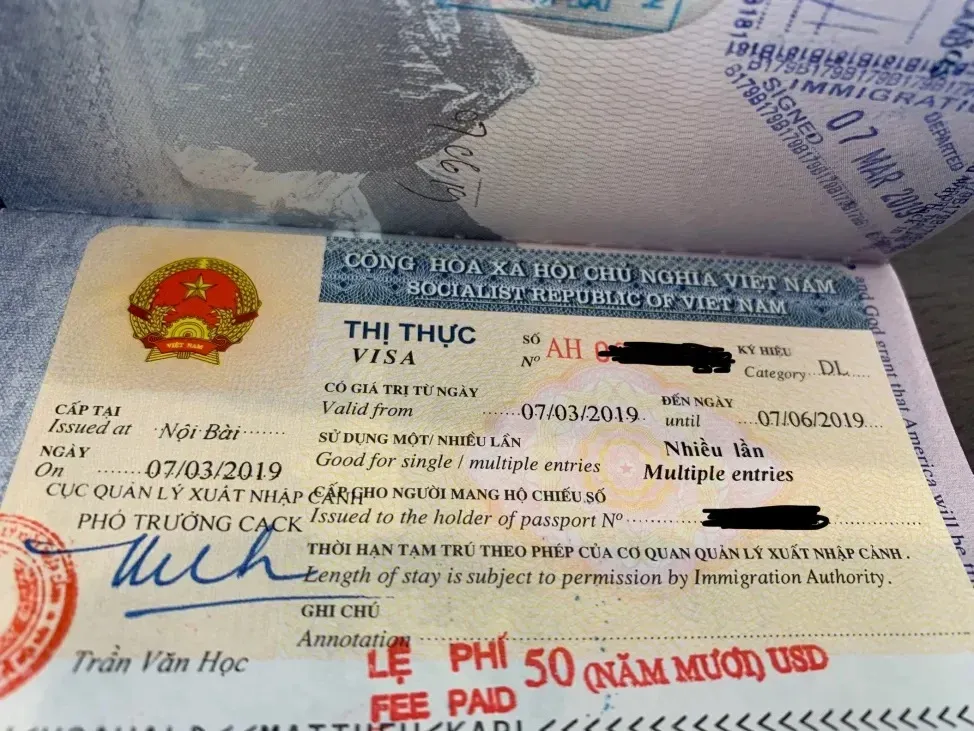
The official fee for a multiple-entry Vietnam e-visa is US$50.
This is US$25 more than the official single-entry fee.
Who Should Consider a Multiple-Entry E-Visa?
A multiple-entry e-visa may be relevant if:
You plan to leave Vietnam and return during the same trip.
Your itinerary includes Vietnam and other countries.
You expect to enter Vietnam more than once during the visa validity period.
You want your visa to accommodate multiple Vietnam entries within its validity period.
Vietnam E-Visa Single vs Multiple Entry: Which Is Right for Your Trip?
There is no universal option for every traveler. The appropriate choice depends mainly on your itinerary.
Choose Single Entry If You Are Staying in Vietnam
Suppose your itinerary is:
Hanoi → Ha Long Bay → Ninh Binh → Hue → Hoi An → Ho Chi Minh City
You enter Vietnam at the beginning of your trip and leave only once at the end.
In this situation, you only need one entry into Vietnam, so a single-entry e-visa may be sufficient.
Choose Multiple Entry If You Plan to Leave and Return
Now imagine:
Hanoi → Da Nang → Bangkok → Ho Chi Minh City → Home
Here, you enter Vietnam, leave for Thailand, and then enter Vietnam again.
A multiple-entry e-visa is designed for this type of itinerary because it allows multiple entries during the visa's validity period.
Apply Visa in Vietnam
Consider Multiple Entry for a Multi-Country Trip
Vietnam is often included in Southeast Asian travel itineraries alongside destinations such as Thailand, Cambodia, Singapore, Laos, and Malaysia.
For example:
Vietnam → Cambodia → Vietnam
or:
Vietnam → Thailand → Vietnam
If your travel plans require you to leave Vietnam and return, make sure your visa type supports the second entry.
Vietnam E-Visa Single vs Multiple Entry: Examples
Understanding the difference becomes easier when you look at common travel scenarios.
Example 1: One Continuous Vietnam Trip
Itinerary:
Hanoi → Ninh Binh → Ha Long Bay → Da Nang → Hoi An → Ho Chi Minh City
You enter Vietnam once and leave once at the end of your trip.
Potential option: Single entry.
Example 2: Vietnam and Thailand
Itinerary:
Hanoi → Da Nang → Bangkok → Ho Chi Minh City
You leave Vietnam for Thailand and then return to Vietnam.
Potential option: Multiple entry.
Example 3: Vietnam and Cambodia
Itinerary:
Ho Chi Minh City → Phnom Penh → Ho Chi Minh City
You enter Vietnam, travel to Cambodia, and then return to Vietnam.
Potential option: Multiple entry.
Example 4: Vietnam Only
Itinerary:
Ho Chi Minh City → Da Lat → Nha Trang → Hoi An → Hanoi → Home
You stay in Vietnam throughout your trip.
Potential option: Single entry.
The key question is simple:
Will you need to enter Vietnam more than once during the validity period of your e-visa?
If the answer is no, a single-entry visa may be sufficient. If the answer is yes, you should consider a multiple-entry e-visa.
Vietnam E-Visa Single vs Multiple Entry: Cost Comparison
One of the most noticeable differences is the official application fee.
Visa Type
Official Fee
Single-entry Vietnam e-visa
US$25
Multiple-entry Vietnam e-visa
US$50
The Vietnam Immigration Department's online application system currently lists US$25 for a single-entry e-visa and US$50 for a multiple-entry e-visa.
If your itinerary only requires one entry, there may be no reason to select multiple entry solely because it offers more flexibility.
On the other hand, if you know you will leave Vietnam and return, choosing the appropriate entry type from the beginning can help avoid problems with your travel plans.
How Long Is a Vietnam E-Visa Valid?
Vietnam e-visas can be issued with a validity period of up to 90 days. They can be issued for either single or multiple entry.
However, the validity period should not be confused with the number of entries.
Single Entry
A single-entry e-visa can be valid for up to 90 days, but you can use it for one entry.
Multiple Entry
A multiple-entry e-visa can also be valid for up to 90 days, but it can be used for multiple entries during its validity period.
In other words:
Validity = how long the visa can be used.
Entry type = how many times you can enter Vietnam using that visa.
Understanding this distinction can help prevent one of the most common misunderstandings about Vietnam e-visas.
Can You Leave Vietnam and Return With a Single-Entry E-Visa?
No.
A single-entry e-visa is intended for one entry into Vietnam.
For example:
Vietnam → Thailand → Vietnam
If you enter Vietnam using a single-entry e-visa and then leave Vietnam for Thailand, you cannot use that same single-entry visa for your return to Vietnam.
If your itinerary includes leaving Vietnam and returning, make sure you have the appropriate visa arrangement for the second entry.
Can You Enter Vietnam Multiple Times With an E-Visa?
Yes, if you are issued a multiple-entry e-visa.
The Vietnam Immigration Department states that e-visas may be issued for multiple entry and can be valid for up to 90 days.
The multiple-entry option can therefore be useful for travelers whose itinerary involves several separate Vietnam entries during the visa's validity period.
Can You Change a Single-Entry E-Visa to Multiple Entry?
You should not assume that a single-entry e-visa can simply be converted into a multiple-entry e-visa after it has been issued.
If you already know that your itinerary will involve leaving Vietnam and returning, it is better to select the appropriate entry type when completing your application.
If your travel plans change after your visa has been issued, check the latest requirements and procedures with the Vietnam Immigration Department rather than relying on an assumption that your existing visa can be changed.
Common Mistakes When Choosing Vietnam E-Visa Entry Type
Common Mistakes When Choosing Vietnam E-Visa Entry Type
1. Thinking Single Entry Means One Day
"Single entry" does not mean you can stay for only one day.
It refers to the number of times you can enter Vietnam using the visa.
The visa's validity period determines the period during which the visa can be used.
2. Forgetting About a Side Trip
A traveler might plan:
Hanoi → Ho Chi Minh City → Bangkok → Home
and assume that leaving Vietnam does not affect the visa.
However, if you plan to return to Vietnam after your Bangkok trip, you need to make sure your visa arrangement supports another Vietnam entry.
3. Looking Only at the Price
The single-entry option costs less, but the cheapest option is not necessarily the appropriate option for every itinerary.
The most important factor is how many times you plan to enter Vietnam.
4. Confusing Validity With Entries
A visa valid for 90 days does not automatically mean you can enter Vietnam multiple times.
Always check whether the visa is issued as single entry or multiple entry.
5. Not Checking Your Visa After Approval
Once your e-visa is approved, check the information carefully before traveling.
Pay attention to:
Name
Passport number
Date of birth
Visa validity dates
Entry type
Entry checkpoint
Exit checkpoint
If you notice an issue, seek clarification from the relevant Vietnamese immigration authority before your trip.
How to Apply for a Vietnam E-Visa
The Vietnam e-visa application is completed online for eligible foreign travelers outside Vietnam.
The official system requires applicants to provide the requested information, upload a passport data-page image and portrait photograph, select the visa type, and pay the applicable fee. The system then provides a registration code that can be used to check the application result.
The current official e-visa portal operates through evisa.gov.vn and thithucdientu.gov.vn, according to the Vietnam Immigration Department.
When applying, make sure you select the correct option:
Single entry
Multiple entry
Your choice should reflect your actual travel itinerary.
Vietnam E-Visa Single vs Multiple Entry: Quick Summary
Question
Single Entry
Multiple Entry
How many times can you enter Vietnam?
Once
Multiple times
Official fee
US$25
US$50
Maximum validity
Up to 90 days
Up to 90 days
Can you leave and return using the same visa?
No
Yes, during validity
Suitable for
One continuous Vietnam trip
Multi-country or multiple-entry itinerary
The Vietnam Immigration Department confirms the current official fees of US$25 for single entry and US$50 for multiple entry.
Conclusion
Choosing between a Vietnam eVisa single entry and multiple entry depends on your travel plans. A single-entry eVisa is suitable for travelers visiting Vietnam once, while a multiple-entry eVisa offers greater flexibility for those planning to leave and re-enter the country during the visa validity period. Consider your itinerary, travel frequency, and budget to select the option that best fits your needs.